
The Nordic Heritage Center
View the presentation below to understand our proposal for establishing a Nordic Heritage Center in the greater Salt Lake City area. Also, check out the FAQs section at the bottom of the presentation for answers to many of the questions we've heard so far. And if you are ready to make your contribution as a volunteer, committee member, board member, or donor, click on the "Ready to Contribute?" button below.

The following proposal was made by Stewart Shelline, Communications Director of Sons of Norway in Utah, to members and friends of the Icelandic Association of Utah, the Swedish Heritage Society, and the Sons of Norway Leif Erikson Lodge on March 21, 2026 at the Garden Park Clubhouse in South Jordan, Utah.

Introduction
I chose this picture to begin my presentation for several reasons:
-
It’s a picture from my own family history on the occasion of Karl Johannessen returning to Norway in 1912. Karl was the younger brother of my great-grandmother, Inga Tomine Johannessen. Three of her children are also pictured, including my grandfather, as well as other immigrants from Norway and Scandinavia.
-
It beautifully represents the love they had for the country they had left behind, shown in the Norwegian flag and rosemaled wooden key at the back. They were proud of who they had been and who they were becoming, embracing new circumstances but not rejecting the past even when it may have been painful.
-
Every family has a picture like this. If not in a family album, then in the letters or journals or memories of family members.
I discovered this picture just a few years ago because someone with the username TBacon had the presence of mind to preserve it, scan it, and upload it to FamilySearch. TBacon and Christina Otterstrom Carter went further and identified most of the individuals in this photo. I am grateful to these two–and all who feel compelled to preserve history–for this act of preservation.
This is the same motivation that drives organizations like the Swedish Heritage Society, the Icelandic Association, Sons of Norway, and others. To preserve and keep alive such memories for the generations to come. So that we, and they, can remember where we came from.
It is the same motivation that brings us together today as we propose the establishment of a Nordic Heritage Center in the greater Salt Lake Area. This center will support the preservation, promotion, and celebration of Nordic culture by providing dedicated spaces in which we can present the stories of Nordic contributors to the building of Utah and the Mountain West. This space will be devoted to telling these stories through exhibits, music, dance, food, crafts, lectures, celebrations, and more.
But before we jump into the details of our proposal, let’s first answer a few questions you may be thinking.

The nature of Nordic culture
Recent Olympics success notwithstanding, Nordic culture is much more than skiing and winter sports. In a landscape shaped by ragged shorelines and deep fjords; dense forests and flat farmland; flaming volcanoes and arctic ice, the peoples of the Nordic countries have developed distinct islands of culture across these widely separated lands--and even from valley to valley.
Broadly speaking, Nordic culture encompasses a deep-rooted connection to nature, a strong emphasis on egalitarianism, social welfare, and individual autonomy, and a religious legacy shaped by Norse paganism, Christianity, and the Protestant Reformation--and for many Nordic immigrants to Utah, an escape from this legacy. Yet Nordic immigrants to Utah cherish the best of their ancestral connections and seek to pass them on to future generations.
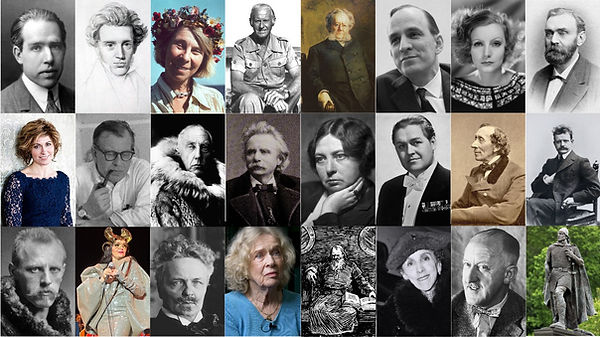
The faces of Nordic culture
The rugged landscapes and extreme climates of the Nordic countries have produced some of the world’s greatest artists, musicians, composers, explorers, politicians, and philanthropists, among them (top left to bottom right): Niels Bohr, Søren Kierkegaard, Tove Jansson, Thor Heyerdahl, Henrik Ibsen, Ingmar Bergman, Greta Garbo, Alfred Nobel, Sissel Kyrkjebø, Eero Saarinen, Roald Amundsen, Edvard Grieg, Sigrid Undset, Jussi Bjorling, Hans Christian Anderson, Jean Sibelius, Fridtjof Nansen, Björk, August Strindberg, Liv Ullman, Snorri Sturluson, Karen Blixen, Halldór Laxness, and Leif Erikson.
Their contributions have stood the test of time and continue to resonate with modern audiences. They left a legacy that has helped shape our world and our place in it.

Everyday Nordic culture
Yet some of the most enduring–and loved–aspects of Nordic culture came not from the halls of power or fame, but from the home and village: music, dance, food, fabric, folk arts, the simple architecture of homes, barns, sheds, and tools.

But why preserve it?
Americans from Nordic countries have an important story to tell about immigration, assimilation, and the challenges inherent in preserving the culture from which they came. There are artifacts– everyday objects like clothing, household goods, and jewelry–that are essential to a full telling of these stories. There are cultural practices–music, dance, celebrations, food--that also help tell these stories through contemporary expression.
These stories–and the artifacts and practices that illustrate them–are in danger of being lost, forgotten, muted, or discarded. Without space to physically preserve and display these artifacts, they will inevitably be lost. While there are a variety of organizations representing the Nordic countries in Utah, none of them have ever had a space dedicated to fully preserving, promoting, celebrating, and engaging with Nordic culture.

Can Utah support such an institution?
Utah has some of the highest concentrations of Nordic people in the country. In fact, Sanpete, Cache, and Utah counties are in the top 20 with respect to population with Scandinavian heritage. It is estimated that as many as 500,000 people with Nordic heritage live in Utah--more than 14% of the state's population. Thousands more live in states that border Utah.

While there are dozens of Scandinavian, Nordic, and country-specific cultural centers and museums across the United States, the closest to Utah are still hundreds of miles away. Surprisingly, there is not a single institution dedicated to any of the Nordic countries--individually or collectively--within 600 miles of Salt Lake City.

In addition, the Salt Lake City metro area compares favorably with other successful Nordic cultural centers in the United States in terms of overall population density. With Salt Lake City's proximity to nearby ski resorts and red rock country as well as its status as a (future) two-time Winter Olympics host, the Salt Lake area is well-positioned to host a regional cultural center.

Where would the center be located?
Let’s talk about where the center could be located. While sites north and south of Salt Lake County could be attractive options, we have chosen to focus on Salt Lake County for our proposal. The county is blessed with a variety of potential locations for a regional Nordic cultural center, including:
-
The Salt Lake City cultural arts corridor (roughly from the State Capitol on the north to the City/County Building on the South and from 10th West to the foothills on the east).
-
This is the Place Heritage Park
-
Utah Olympic Park
-
Cottonwood Paper Mill site
-
Midvale Main St. RDA
-
Downtown Daybreak
-
The Point (Point of the Mountain)
-
Thanksgiving Point
An ideal location would include:
-
At least 1 acre of ground
-
Adequate on-site parking or with adequate public parking nearby
-
Sufficient foot-and-vehicle traffic to support retail operations
-
Good access to main travel corridors.
-
Room to grow

The Building
We estimate the center will need between 15,000 and 20,000 square feet to adequately fulfill its mission. There is a reason we elected to host tonight’s event in this building: In many ways, it mirrors the building we would like to have in terms of square footage, grounds, architecture, fitout, etc. At more than 13,000sf, it is roughly the same size as our proposed 15,000sf.
We also look to similar institutions across the United States for inspiration, including two that we have looked most closely at: the National Nordic Museum (~57,000sf) in Seattle, Washington and the Vesterheim Museum (~20,000sf) in Decorah, Iowa.
Of course, decisions about the actual design will be left to the future center’s board of directors, but we wanted to give you a sense of what has been done for inspiration.

Components of the building
We propose the following components in the building:
-
A main event hall and foyer (similar to the space we are currently in). This space would be suitable for larger gatherings such as weddings, receptions, dinners, and community events.
-
A museum and library to display the artifacts we collect and to share the information we gather.
-
Meeting rooms for Nordic organizations to use for their own programming.
-
A store attached to the museum selling Nordic goods, with its own hours of operation separate from the museum and center.
-
A cafe/bakery specializing in Nordic food, with its own hours of operation separate from the museum, museum store, and center.
-
A commissary kitchen that could be used by the cafe/bakery as well as for demonstrations and events by Nordic organizations and others.
-
Office space for the center.
-
A storage area for museum artifacts with additional security and environmental controls.
-
Storage areas for other functions of the museum as well as cultural organizations.
-
A courtyard gallery and greenspace extending from the main event hall and museum for larger gatherings and events as well as the display of larger museum artifacts.
While giving priority to its core mission, the center would be available for other community organizations and private parties to use. In fact, such rentals will need to be an important source of its revenue.

Estimate of costs
These costs are based on estimated square footage using standard calculations for commercial real estate in the Salt Lake Valley as of March 2026. Estimates for fitout of aspects of the museum are likely to be higher than estimated here, given the specialized needs for security and environmental control of museum spaces and storage.
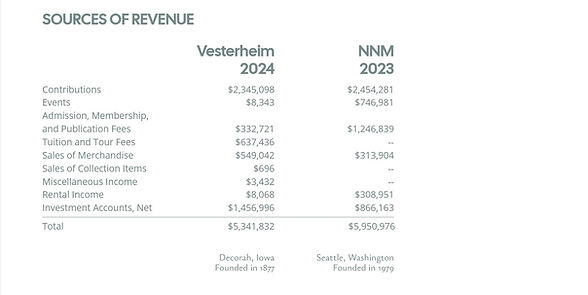
Sources of revenue
Building and operating a facility of this size will not be cheap. To give you an idea of how similar facilities generate revenue, we have examined the 990 forms of the National Nordic Museum and Vesterheim (publicly available on their respective websites). We share these numbers as an indication that these facilities can generate substantial revenue, but caution that these are mature facilities with substantial investment portfolios, robust fundraising mechanisms, and significant museum spaces. Even if successful, it will take years to approach anything like these numbers for a new facility like we are proposing.

Programming
Regular, ongoing programming is intended to support both the Nordic communities in Utah and the Mountain West but also to engage with the broader community by making programming available to all. Such Nordic-themed programming could include:
-
Exhibits from affiliated institutions in Utah, such as universities, museums, etc.
-
Exhibits from institutions outside Utah, such as Vesterheim, Livsreise, Norway, etc.
-
Local and traveling music and dance performances
-
Lectures and presentations
-
Craft demonstrations
-
Cultural celebrations (17.mai dinner, Thorrablot, Midsommer, etc.)
-
Receptions and dinners
-
Guided travel to Nordic countries

-
Fika Friday
-
Taco Fredag
-
Waffle Day
-
Nordic national costume fashion show
-
World national costume fashion show
-
Culinary classes
-
Viking Week
-
Après-ski nights
-
Sports nights. Come watch the Winter Olympics, FIS, World Cup, and other international events.
-
Nordic Film Series
-
Language instruction
-
The First Generation Series: A series of exhibits focused on first-generation individuals and their descendants using artifacts from the family to tell the story.
-
The Notable Nordics Series: A series of exhibits highlighting the contributions of Nordic individuals who made a significant impact on Utah or the Mountain West, such as John Okland, Stein Erickson, the Engen brothers, etc.
-
Family history resources, such as the Scandinavians in Utah project.
Conclusions
-
Cultural preservation and promotion is an ongoing effort that requires individual, family, organizational, and institutional support
-
Utah and the Mountain West have the population density to support a state and even regional Nordic cultural center
-
There is no institution dedicated to preserving and promoting Nordic culture within 600 miles of Salt Lake City
-
There is sufficient cultural competence within the Nordic communities in Utah to support a cultural center.
-
The time is right to establish a Utah Nordic Heritage Center.
Next steps
Obviously, the establishment of a cultural center is a complex process. We are in the earliest stages of discovery and learning. There are many, many decisions to be made before any dirt is turned. However, there are some key steps that should be taken as soon as practical to ensure we move forward in an orderly way. These include:
Entity Formation
-
Select primary officers
-
Secure business name and domain
-
Register as a Domestic Non-profit Corporation in Utah
Organizing a board of directors
The board should include people representing a broad spectrum of skills and experience, especially individuals in the following areas:
-
Fundraising
-
Investment management
-
Real estate development
-
Museum management
-
Museum store management
-
Nordic cultural organizations
-
Marketing
-
Politics and government
-
Food service
-
Potential donors
-
Education
-
Legal
-
Grant writing
-
Religious institutions
Finalizing the business plan
Fundraising

Final thoughts
I’ll end tonight’s presentation with the following quote attributed to Roald Amundsen, the famous Norwegian explorer who knew something about challenging projects:
“When it is darkest, there is always light ahead.”
Not every destination is reached. Not every idea sees fruition. If this proposal, or something like it, is to succeed, it will take the efforts of many people over many years. We invite you to share your skills, your professional experience, your ideas, and your enthusiasm.
Thank you!

FAQs
Where will the money come from to build and operate the center?
To build the center: Generous donors through a capital campaign. To operate the center: The center itself should ultimately fund its operations primarily through program revenue, including admissions fees, facility rentals, retail operations, guided travel, etc. Additional funds would come from local, state, and federal grants as well as returns on investments. Operations would also be supported by an endowment funded by donations and annual fundraising drives.
Who will own the center? How will it be organized and managed?
Institutions like we are proposing are usually formed as 501.c(3) organizations. This organization will own the museum and its assets and oversee its day-to-day operations. The endowment associated with the center could be a separate entity, also formed as a 501.c(3) organization. Each organization will have its own governing board, with a chairman and officers as needed. It is presumed that these boards would also include representatives from a variety of interested parties, including Nordic organizations like Sons of Norway, Swedish Heritage Society, the Icelandic Association of Utah, etc.
Why not partner with an existing institution?
We have not ruled out partnering with other institutions and organizations at this early stage. There may indeed be advantages in working with others, like the Sons of Utah Pioneers, who are similarly engaged in preserving and promoting cultural engagement. However, a cultural center like we are proposing needs to appeal to the broadest possible audience, which means it cannot restrict itself to particular religious, political, or social points of view in its sponsorship, programming, or organization. Of course, we intend to collaborate with a variety of like-minded institutions, organizations, families, and individuals as we share the culture and experiences of the Nordic communities, regardless of their religious, political, or social point-of-view. Among these are the Alf Engen Museum, the University of Utah, Brigham Young University, The Church of Jesus Christ of Latter-day Saints, the International Peace Gardens, the Lutheran churches of Utah, the consulates representing the Nordic countries, and many more.
Is there a significant collection of artifacts ready to be included in a museum/cultural center?
We believe there are a significant number of artifacts relevant to the Nordic communities that could support a museum and library in Utah. However, we are in the early stages of discovery and documentation of what these artifacts and collections are--or could be. We believe that we will need to work closely with existing institutions, including museums, libraries, families, individuals, churches, and others to come to a clear understanding of what is available, what can be shared, and what can be borrowed or acquired. A significant motivation for the Utah Nordic Heritage Center is to discover, document, and exhibit the artifacts that tell the stories we hope to tell.
Couldn't the money spent on building and maintaining a center be better spent on programming and building up existing organizations and venues?
We realize that building and maintaining the center will be a very heavy lift. We realize as well that without large donor support the center will not be realized. So it is natural to ask whether the mission of preserving, promoting, and celebrating Nordic culture could be achieved through other, less costly means. The answer, of course, is that there is more than one way to achieve such goals. Indeed, that may be the conclusion we are ultimately compelled to reach. However, a similar question could also be asked: Does the preservation, promotion, and celebration of Nordic culture need any institutional support at all? Shouldn't this be left to individuals and families? We believe that this mission is deserving of broad and deep community support, from individuals and families to culture-specific organizations to churches and yes, even cultural institutions and buildings. We believe that in the long run, a facility dedicated to this task best honors those whose sacrifices and efforts helped build Utah into what it is today.
What incentives would existing organizations like Swedish Heritage Society, Sons of Norway, Icelandic Association of Utah, etc. have to participate?
The Utah Nordic Heritage Center could address a variety of challenges that cultural organizations face in Utah, including: -- Lack of meeting space. While the Salt Lake County library system provides a variety of free meeting spaces, there are significant downsides to relying on it, including limited hours, lack of guaranteed meeting space, requirement that all meetings be public, etc. There are also numerous private event spaces, but rental fees are expensive and there are no guarantees that space will be available when needed. -- Lack of a permanent address for correspondence and shipping. -- Lack of storage space. -- Lack of kitchen space for food-related activities and demonstrations. A Nordic cultural center could provide relevant organizations priority in scheduling, discounts on events at the center for members of relevant organizations, etc. In return, the cultural organizations could provide a significant amount of programming and fundraising.
What would happen to the Norway, Sweden, Finland, and Denmark gardens at the International Peace Gardens?
The Denmark, Finland, Norway, and Sweden gardens at the International Peace Gardens in Salt Lake City have been the location of many Nordic events and celebrations for many years, among them Sweden's Midsummer and Norway's Syttende Mai celebrations. It is not expected that these events would be held at the Utah Nordic Heritage Center. In fact, we would hope that the center would become a major supporter of events at the Peace Gardens as well as significant contributors to their maintenance and improvement. However, if the gardens cease to be a viable place for celebrating Nordic events--for example, if the gardens were relocated or allowed to fall into disrepair again--the Utah Nordic Heritage Center could be in a position to pick up the slack. This implies that plans for the UNHC should include outdoor spaces suitable for larger gatherings as well as the parking and transportation options that support them.